

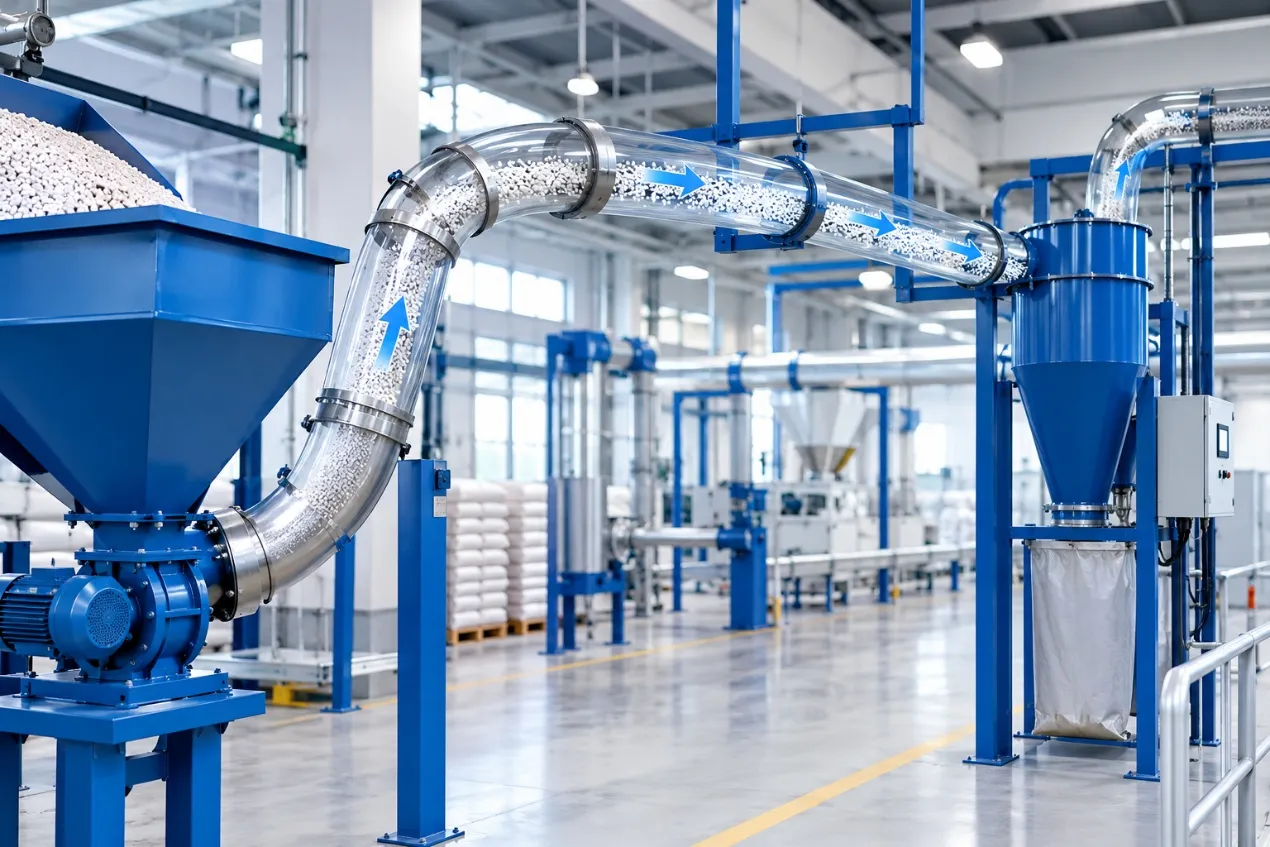
Moving an empty lightweight bottle through a high-speed production environment presents a unique material handling challenge.
Because empty containers have very little mass, conventional conveying methods may not always provide the best solution for moving them rapidly and consistently between processes.
That is where Air Conveyor Systems can play an important role.
What Is an Air Conveyor System?
An Air Conveyor System uses directed airflow to propel lightweight containers through a defined conveyor path.
These systems are particularly associated with empty PET bottle handling and can be used to connect processes such as blow molding and filling.
Rather than transporting containers entirely on a traditional conveyor chain or belt, controlled air movement helps propel them through the system.
Why Use Air for Bottle Conveying?
Empty plastic bottles are lightweight and can be challenging to handle at high production rates. Air conveyor technology is designed specifically around these characteristics.
When properly engineered, Air Conveyors Systems can support continuous container movement, high production rates, efficient routing, and integration between critical pieces of processing equipment.
The system can also reduce the need for conventional conveyor surfaces across portions of the empty-container handling process.
Airflow Must Be Engineered for the Application
More air does not automatically mean better conveying.
Airflow must be controlled so containers move predictably through straight sections, curves, transitions, and equipment interfaces.
Container geometry also matters. Bottle size, neck design, weight distribution, and shape can affect how the container behaves within the conveyor.
That means Air Conveyor Systems should be engineered around the specific container and production requirements.
Line Speed and Equipment Integration
An air conveyor cannot be evaluated independently from the equipment it connects.
The system needs to receive containers from upstream equipment at an appropriate rate and deliver them to downstream processes consistently.
Differences in equipment speed, production interruptions, container flow, and system controls should therefore be considered during the design process.
This is where an engineered system approach becomes particularly valuable.
Layout Matters
The shortest path between two machines is not necessarily the best conveyor layout.
An effective layout may need to account for columns, walls, utilities, operator areas, maintenance access, existing machinery, future equipment, and production flow.
Air Conveyor Systems can be configured to route containers through manufacturing environments while supporting the overall line design.
Air Conveyors as Part of a Complete Material Handling System
Air conveying is often only one stage of the production process.
Once containers are filled or move farther into packaging, another conveyor technology may be better suited to the product. Table Top Conveyor Systems, accumulation conveyors, and other material handling equipment can therefore work alongside air conveyors within the same production line.
The objective is to use the right technology at each stage while ensuring that all sections operate as one coordinated system.
Engineering Better Product Flow
Reliable conveying depends on more than equipment selection. Product characteristics, production rates, airflow, transfers, accumulation, controls, routing, and integration all need to be considered.
Dillin develops Air Conveyor Systems and engineered material handling solutions around the requirements of the complete production process.
